Click me to go home |

|
|
- Please email, write and phone Representatives Rahall and Whitfield and thank them
for their help in sponsoring legislation to save our wild horses.
- Congressman Rahall's Web Site
- Congressman Whitfield's Web Site
- Please email, write and phone your Congressional Representative and ask that
he/she co-sponsor and support H. R. 297, the Rahall-Whitfield bill.
- Please email, write and phone your Senators and ask them to support a companion bill in the Senate similar to H. R. 297.
- Please email, write and phone the following members of the House Resources
Committee and ask them to support H. R. 297, the Rahall-Whitfield bill.
- Representative Richard Pombo (R-CA) (Chairman of the Resource Committee)
2411 Rayburn House Office Bldg.
Washington, D.C. 20515
(202) 225-1947
(202) 226-0861 FAX - Representative Devin Nunes, (R-CA) (The new Subcommittee Chair)
1017 Longworth House Office Bldg.
Washington, DC 20515
(202) 225-2523
(202) 225-3404 FAX - Representative Jim Gibbons, (R-NV)
100 Cannon House Office Bldg.
Washington, D.C. 20515-2802
(202) 225-6155
(202) 225-5679 FAX
In addition you can email the Resources Committee at [email protected].
- Representative Richard Pombo (R-CA) (Chairman of the Resource Committee)
- In the mid 1800’s, two to three million wild horses roamed the western
states.
- By 1950, wild horses and burros were nearly eradicated from the
West.
- In 1971, Wild Horse Annie and ISPMB were instrumental in getting Public Law 92-195 (The Wild Free-Roaming Horses and Burros Act) passed that protected
wild horses from capture, branding, harassment, or death. “Congress finds
and declares that wild free-roaming horses and burros are living symbols of
the historic and pioneer spirit of the West; that they contribute to the
diversity of life forms within the Nation and enrich the lives of the
American people; and that these wild free-roaming horses and burros are fast
disappearing from the American scene.”
- In 1974, the first census was done and there were 60,000 wild
horses and burros on public lands.
- Today, there are less than 35,000 wild horses and burros.
- By 2006, there will be only 23,000 wild horses and burros left.
- Viable populations of wild horses and burros must have a minimum of
150 animals in each Herd Area (University of Kentucky). This absolute
minimum is only under ideal climatic conditions. According to these
figures - the absolute minimum number is 30,150 wild horses and burros -
that is if there is no drought or harsh winters, fires or other acts of God.
- BLM’s regulation - CFR 4710.5 “closure to livestock” is to be
implemented to protect wild horses and burros during negative climatic
conditions by removing livestock. Emergency gathers for the past fourteen
years would not have taken place if BLM had implemented this CFR.
- Most biologists believe that populations should be a minimum of 500
animals to maintain viability.
- By 2006, 70% of the Herd Areas will have less than 100 animals in
each one.
- Now, wild horses have far more genetic variability compared to any
particular breed of horse in our country. (University of Kentucky)
- Drastic reductions in numbers as proposed by the Bureau of Land
Management (BLM) will lead to the loss of this great variability.
- In 1971, there were 303 Herd Areas and now only 201 Herd Management
areas remain.
- The Bureau of Land Management manages 261,950,378 acres.
- Wild horses and burros reside on only 34,549,570 acres down from
47,495,879 acres in 1984.
- Public Law 92-195 requires BLM to manage “principally” for wild horses and
burros in the areas where found, however - livestock represent the major
users in most of the Herd Areas.
Downloadable Fact Sheets
MS Word Format
Adobe (PDF) Format
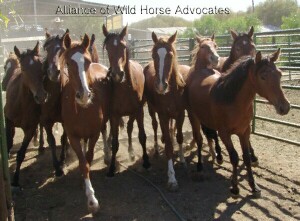
Alliance of Wild Horse Advocates
RECOMMENDED ACTION NOTEBOOK
Actions For the Week of January 31 through February 6
H.R. 297, a bill introduced by Congressmen Rahall and Whitfield that would repeal the most troublesome aspects of the Burns rider, has been filed in the House of Representatives. We need to support this effort and urge our own Congressmen to take similar action. (To read the bill, click here.)
Goals for This Week:
Sample Letter
We are asking for your help today to restore the protections granted to wild horses and burros since1971by supporting the Rahall/Whitfield bill - H.R. 297. Wild horses are America’s great icons representing the symbol of freedom that our country so cherishes.
As you know, the support for wild horses crosses all political, cultural, and social lines. This bill will halt the slaughter of 8,400 wild horses that are now awaiting their death warrant. Your support will help to restore the public’s confidence by assuring us that Congress operates under the principals of “for the people and by the people.” As you know, the public had no knowledge or input about the change in the Wild Horses and Burros Act, because the rider that altered the Act was surreptitiously added to the federal spending bill last November.
We trust that you will rectify this terrible injustice done to our last living symbols of the Old West, our wild horses and burros. They truly do “enrich the lives of the American people.”
Sincerely,
(Your Signature)
Fact Sheet