Click me to go home |

|
|
Report from
Animal People
Bill introduced to halt wild horse slaughter; horse lovers rally
Meritt Clifton, EditorWASHINGTON D.C., RENO-- U.S. Representatives Nick J. Rahall (D-West Virginia) and Ed Whitfield (R-Kentucky) on January 25 introduced a bill to restore to wild equines the full protection extended by the 1971 Wild & Free-Roaming Horse & Burro Protection Act.
The Rahall/Whitfield bill, HR-297, would repeal a stealth rider attached by Senator Conrad Burns (R-Montana), to the Consolidated Appropriations Act passed by Congress on November 18, 2004.
"If allowed to stand, the Burns provision will lead to the slaughter of thousands of wild horses for human consumption abroad," summarized American Horse Defense Fund attorney Trina Bellak.
An impromptu demonstration of the symbolic significance of wild horses to the American public came on January 21 at Damante Ranch High School in Nevada.
Fearing that the Nevada Department of Agriculture was rounding up mustangs to sell to slaughter, 30 to 40 students left their classes, marched to the temporary corral in two separate groups, so that if one group was intercepted the other might get through, and released about a dozen horses who had already been captured with hay as bait.
The Damante High athletic teams are called the Mustangs.
Nevada Department of Agriculture spokesperson Ed Foster told Don Cox of the Reno Gazette-Journal that the horses were captured for relocation, after moving into the neighborhood during heavy snows in the nearby Virginia Range. Foster said that the students would not be criminally charged because they "thought they were doing a good thing."
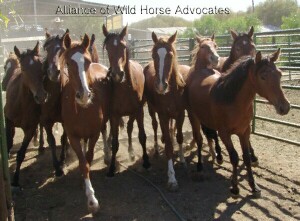
The students acted just under three weeks after more than 100 wild horse defenders from 33 organizations formed the Alliance of Wild Horse Advocates in Carson City on January 2 and 3, to respond to the Burns rider.
The Burns rider directed the Bureau of Land Management to make "available for sale without limitation" any captive wild horse who is more than 10 years old or who has been offered for adoption at least three times.
Most of the 14,000 wild horses now held by the BLM may be sold to slaughter, said International Society for the Protection of Mustangs & Burros president Karen Sussman.
The 3,600-page, $388 billion spending act was signed into law by U.S. President George W. Bush on December 6, 2004.
"Despite losing most of the California, Oregon, and Idaho delegations due to near blizzard conditions over the mountain passes," Nevada wild horse enthusiast Willis Lamm said, "the Alliance of Wild Horse Advocates organizing conference achieved most of its objectives. In the years that I have been involved with wild horse issues, I have never before seen such camaraderie. The conference established a number of working groups, who started addressing a host of specific issues and objectives. These working groups will confer via the Internet to develop and implement their assigned tasks."
The Alliance of Wild Horse Advocates agreed on a nine-point statement of common understanding of the issue:
- In 1971, the Wild & Free-Ranging Horse & Burro Protection
Act stated that wild horses were fast disappearing from the American
scene.
- Since 1971, the Bureau of Land Management has not
complied with the Act to protect wild horses and burros on public
lands.
- Today there are fewer wild horses and burros on public
lands than in 1971.
- The BLM has created a myth that wild horses and burros
are overpopulating.
- The BLM designation of older mustangs as unadoptable is a myth.
- Because of this myth, the BLM has created a quagmire of
wild horses in long-term holding pastures who rightfully belong back
on the range.
- The Burns stealth rider dismantled the Wild &
Free-Roaming Horse & Burro Protection Act.
- This was done without the knowledge of the American public.
- A majority of Congress were unaware that this last-minute rider was attached to the federal appropriations bill.
Western beef boycott?
"During TV coverage of the inaugural parade," Trina Bellak observed to fellow Alliance of Wild Horse Advocates members on January 21, "the news anchor described an equestrian group as it appeared on the screen, and mentioned that they counted amongst their members some Senators and Representatives --including Senator Burns. Needless to say nothing was mentioned about his betrayal of wild horses and burros."
Increasing public awareness of the plight of wild horses and burros is the first goal of the Alliance of Wild Horse Advocates.
"While it is not our intent to promote economic sanctions at this time," Lamm suggested, "I think it is not a bad idea for those who are involved with campaigns such as 'Eat Something Else!!!' and 'Quit Beefin'' to encourage the development of some kind of cooperative market for mustang-friendly beef."
As ANIMAL PEOPLE went to press, both that idea and the idea of trying to promote boycotts of western range beef and Montana tourism seemed to be gaining momentum.
"It is fatuous to argue that 30,000 wild horses roaming the West are degrading the region's arid lands," Humane Society of the U.S. president Wayne Pacelle wrote to The New York Times, "when there are more than four million livestock grazing on those same lands. Where population reductions are well justified, nonlethal strategies like contraception should take the place of costly roundups, which are now just an antecedent to the slaughter of horses for export to foreign markets for human consumption."
But seething rancher opposition to sharing leased range with wild horses was evident in Elko County, Nevada, on January 10, when the county commissioners discussed suing the federal government to seek expanded and expedited wild horse roundups--and the only reported opposition came from a commissioner who said the county couldn't afford to fight the Department of the Interior.
Western States Wild Horse & Burro Expo director Nancy Kerson meanwhile found that the BLM has already removed older horses from its online adoption web site. Kerson explained on Lamm's www.KBRhorse.net web site that she called the BLM wild horse holding facility at Burns, Oregon to ask what was happening, and was told that listing older horses for adoption is now illegal, since "under the new law they can only be sold, not be adopted. But the BLM is hoping that would-be adopters will be able to buy them," Kerson added.
"When the American people understand what the [Burns] measure really means, they will rally to our cause," predicted National Wild Horse Association vice president Laurie Howard to Tim Anderson of the Reno Gazette-Journal.
Birds on hit list too
The Consolidated Appropriations Act also included a stealth rider that exempts any birds deemed "introduced" and "non-native" from protection under the 1918 Migratory Bird Treaty Act, which animal advocates have invoked several times to stop mass exterminations of mute swans and non-migratory giant Canada geese.
Many other species may be killed. "We have tried to make the list as comprehensive as possible," wrote John L. Trapp of the U.S. Fish & Wildlife Service, Division of Migratory Bird Management, in preface to publishing the roster of 113 potential target species. "It is not, however, an exhaustive list of all the non-native species that could potentially appear in the U.S. or its territories as a result of human assistance," Tripp continued. Any other introduced non-native species might also be designated for massacre.
The Maryland Department of Natural Resources is preparing to oil the eggs of mute swans this spring, and has acknowledgd that adult swans may be shot this summer.
"Federal and state wildlife agencies are once again jumping the gun in their fervor to kill mute swans," said Michael Markarian, formerly president of the Fund for Animals and now executive vice president for external affairs at HSUS, following a merger of the two groups that became official on January 1.
Markarian hinted that HSUS would again seek to protect the swans with a strategy based on the impact study requirements of the National Environmental Policy Act, a strategy which has had some past success.
"The Maryland mute swan population has been unfairly blamed for the loss of submerged aquatic vegetation in Chesapeake Bay," Markarian continued. "As the court pointed out," in a previous ruling that delayed a proposed mute swan extermination campaign, "the state of Maryland's own experts have characterized the 'bay-wide' impact of mute swans as 'negligible.' The waste run-off from chicken factory farms and the sewage treatment plants on Chesapeake Bay kill dramatically more vegetation than the tiny population of swans. Moreover," Markarian said, "Maryland's mute swan population has been declining without lethal control--from approximately 4,000 birds in 1999 to 3,600 in 2002, the last year for which data is available."
From ANIMAL PEOPLE, January/February 2005. Content of this reproduction © Animal People. All rights reserved.
[ANIMAL PEOPLE is the leading independent newspaper providing original investigative coverage of animal protection worldwide, founded in 1992. For additional animal news or to subscribe, please visit Animal People at www.animalpeoplenews.org.]